How to Solve a Wend Puzzle: A Real Board, Step by Step

Most Wend advice is a list of tips. This is the other thing: one real board, solved from the first look to the last tile, with a screenshot at every turn. The board is Medium level 1, a 6×6 grid that is open to everyone, so you can keep it in another tab and trace along. It is worth the ten minutes for one reason: this grid has at least eight four-letter words on legal paths (KNOW, RULE, READ, DATE, LATE, TEST, LEST and THUS) and room for exactly one of them. Working out which is the whole game.
A line of context first. Wend is the word-path game LinkedIn added to its daily games in June 2026. Grid Leveling is an independent site, not affiliated with LinkedIn, that makes its own boards under the same rules: drag through adjacent letters, up, down, left or right, never diagonally, until every letter tile belongs to exactly one word. The rules page has the short version.
What the Board Tells You Before You Move
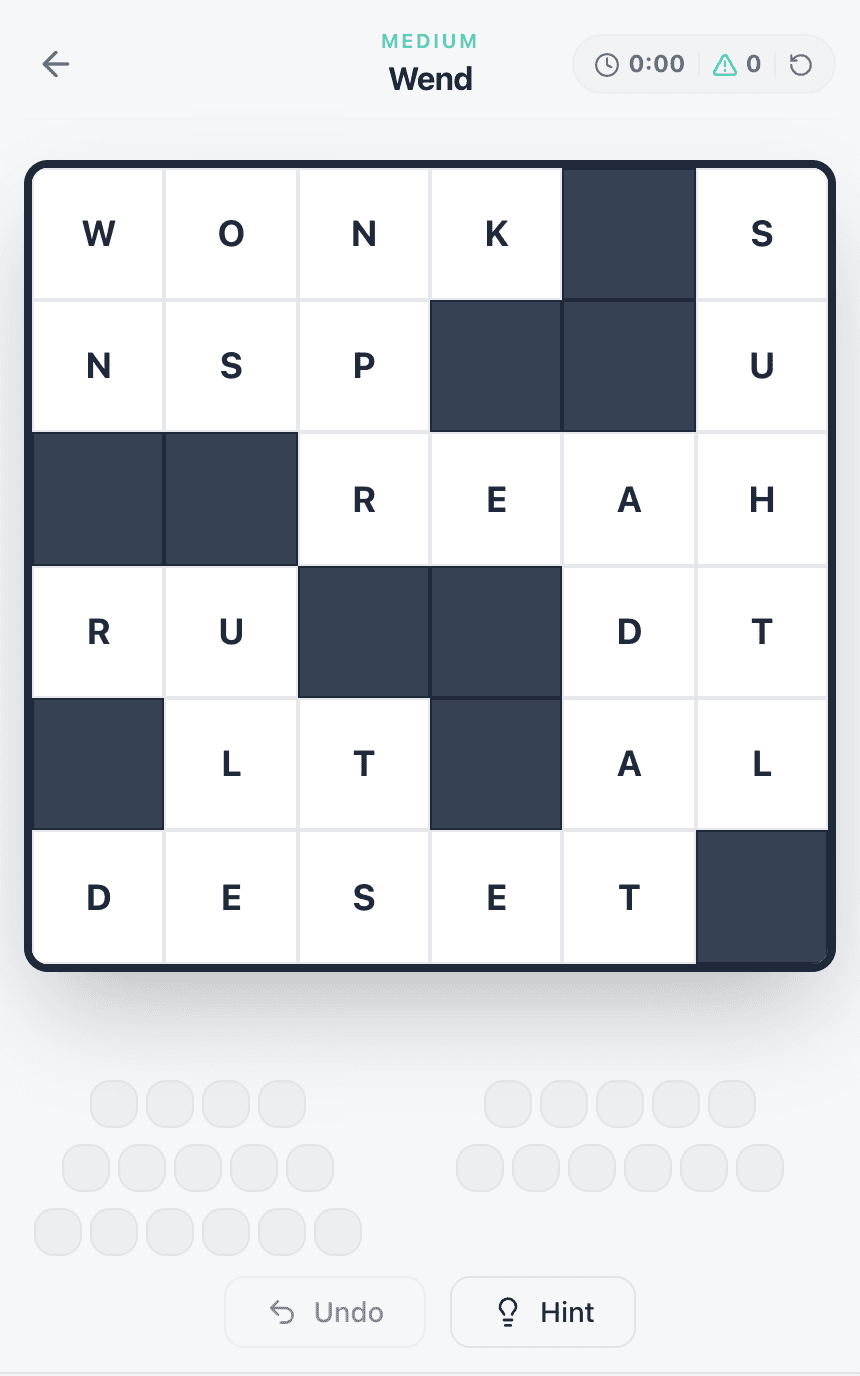
Wend never shows you the word list. What you get is the row of empty slots under the grid, and on this board they read four, five, five, six and six letters. Add them up: 26. Count the letter tiles: 36 squares minus ten walls is 26. That is not a coincidence, it is the rule the whole puzzle hangs on. Every tile is used, and no tile is used twice.
So before tracing anything, write down the two facts that will do most of the work later: there is one four-letter word, and there is no three-letter word at all.
Step 1: Find the Dead Ends
A path enters a tile from one neighbour and leaves by another. A tile with only one open neighbour cannot do both, so it has to be the first or the last letter of its word. Those tiles are where every solve should start, because they turn "where is a word?" into "what word starts here?"
- The S in the top-right corner: a wall on its left, and only the U below it.
- The K in the top row: walls to its right and underneath, and only the N on its left.
- The R on the left edge: walls above and below, and only the U beside it.
- The D in the bottom-left corner: a wall above, and only the E beside it.
Four dead ends on a five-word board is generous. Each of them is one end of a word, which means most of this grid is already spoken for.
Step 2: The Corner S Spends the Only Four-Letter Slot
Start at the S. Its only neighbour is the U, and the U's only other neighbour is the H, so the first three tiles are not a choice: S, U, H. From the H the path can go left to an A or down to a T. Nothing begins S-U-H, so the S must be the last letter of its word rather than the first, and of the two ways to arrive only one spells anything: T-H-U-S, THUS. No letter next to that T makes a longer word ending in THUS, so it stops there, at four letters.
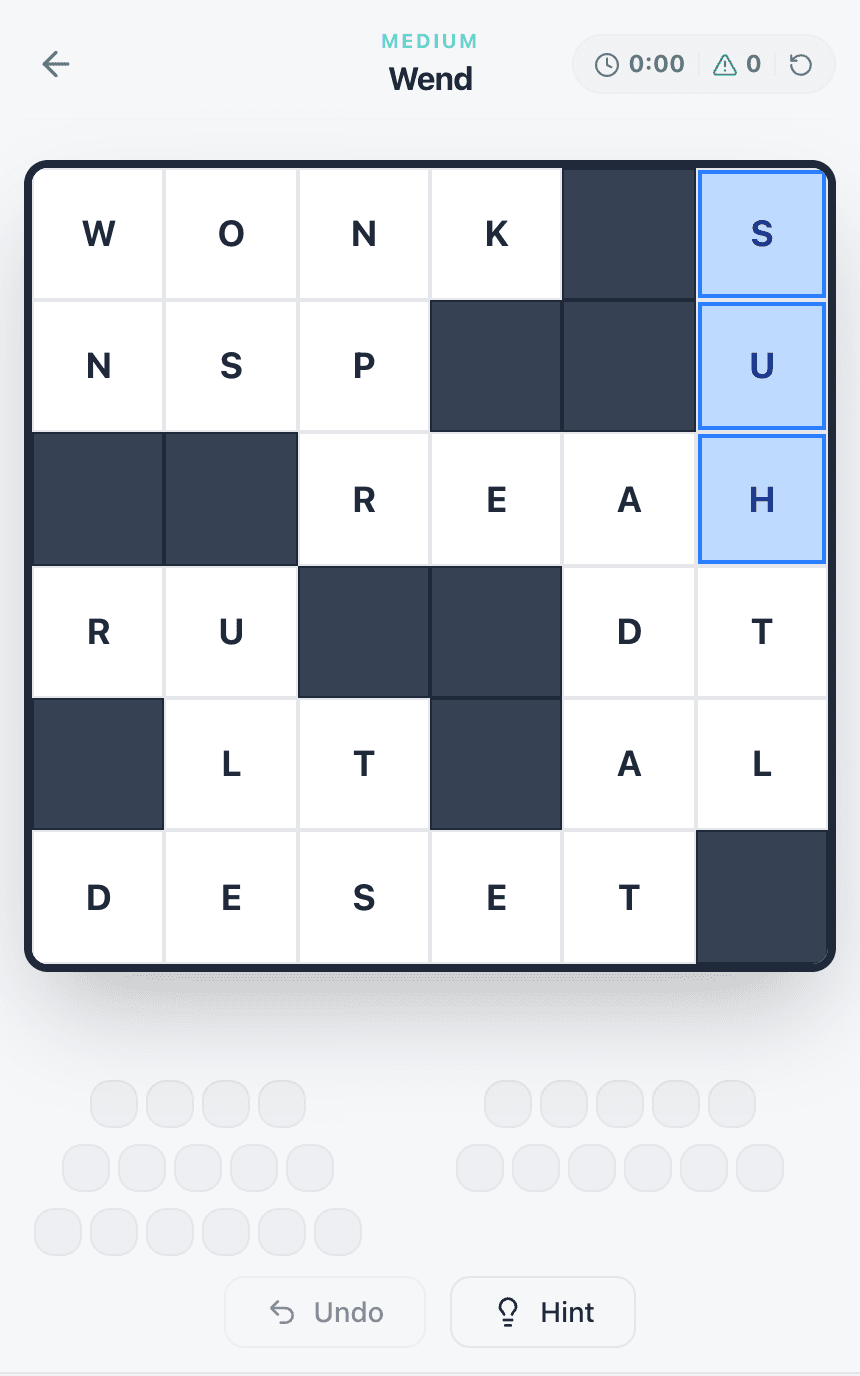
Two things happened there. THUS was read tail first, which is worth knowing: read from the pinned end, then trace from the T. And the board's single four-letter slot is now gone. KNOW, RULE, READ, DATE, LATE, TEST and LEST are all still sitting on the grid in plain view, and not one of them can be an answer. The slot count ruled out seven words without a single trace.
Step 3: K Has to Run On to KNOWN
From the K the top row reads K, N, O, W. That is KNOW, a perfectly good word with nowhere to go, because the four-letter slot is spent. So the path continues, and the W has exactly one neighbour left: the N underneath it. KNOWN, five letters. If you want a second reason, look at what KNOW would have left behind: that N cut off with nothing beside it but an S, and no word starts N-S.
Step 4: A New Dead End Appears, and SPREAD Has No Choices
Placing a word changes the board. The S under the O used to have three neighbours; KNOWN took two of them, so that S is now a dead end with only the P beside it. Follow it: the P leads only to the R, the R only to the E, the E only to the A. The A could once have turned up to the H, but THUS owns that tile, so the only way on is down to the D. Six tiles, zero decisions: SPREAD. Notice READ inside it. That is how a word you can see on the board can be no part of the answer.
Step 5: A Real Word the Game Refuses
Now the left edge. From the R: U, then L, then E, and the E offers two endings. Turn right onto the S and you have RULES. Turn left onto the D and you have RULED. Both are real words, both are five letters, both are legal paths, and there is a five-letter slot waiting. This is the moment Wend stops being a word search.
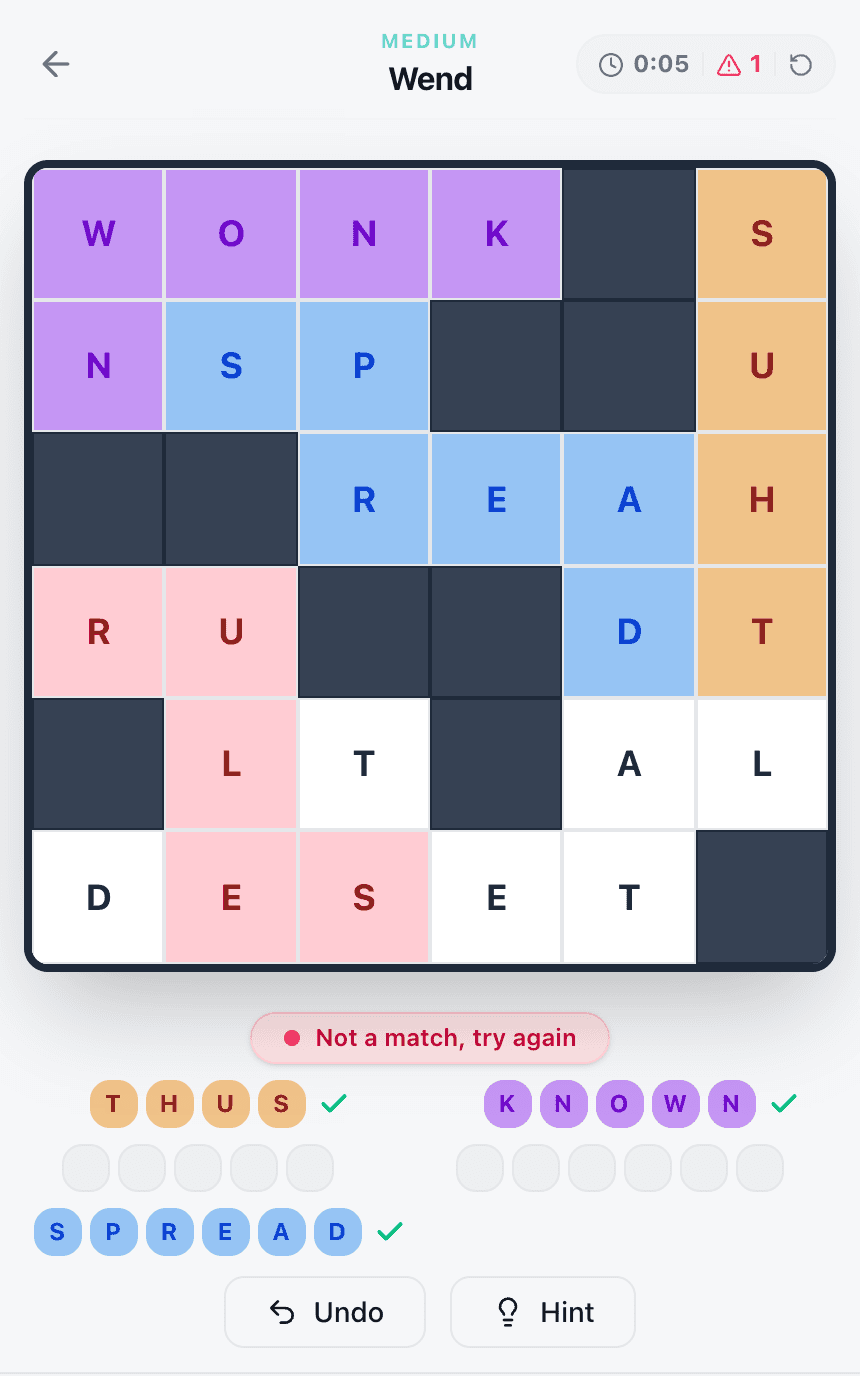
The reason is in the corner. The D was a dead end from the start: its only neighbour is that E. If RULES takes the E, the D is sealed off with no neighbour at all, and a board with a stranded tile cannot be finished. So the word is RULED, running from one dead end to the other. A path is only right if everything it leaves behind can still be covered.
This is also how the game itself judges you. Every board is generated with exactly one way to cover it, and a trace is accepted only if it matches that covering. Two useful consequences: a word that turns a colour is always correct, so you never need to doubt what is already placed; and a refused trace does not mean your word is not a word. It means it does not fit the tiling.
Step 6: Let the Leftovers Finish It
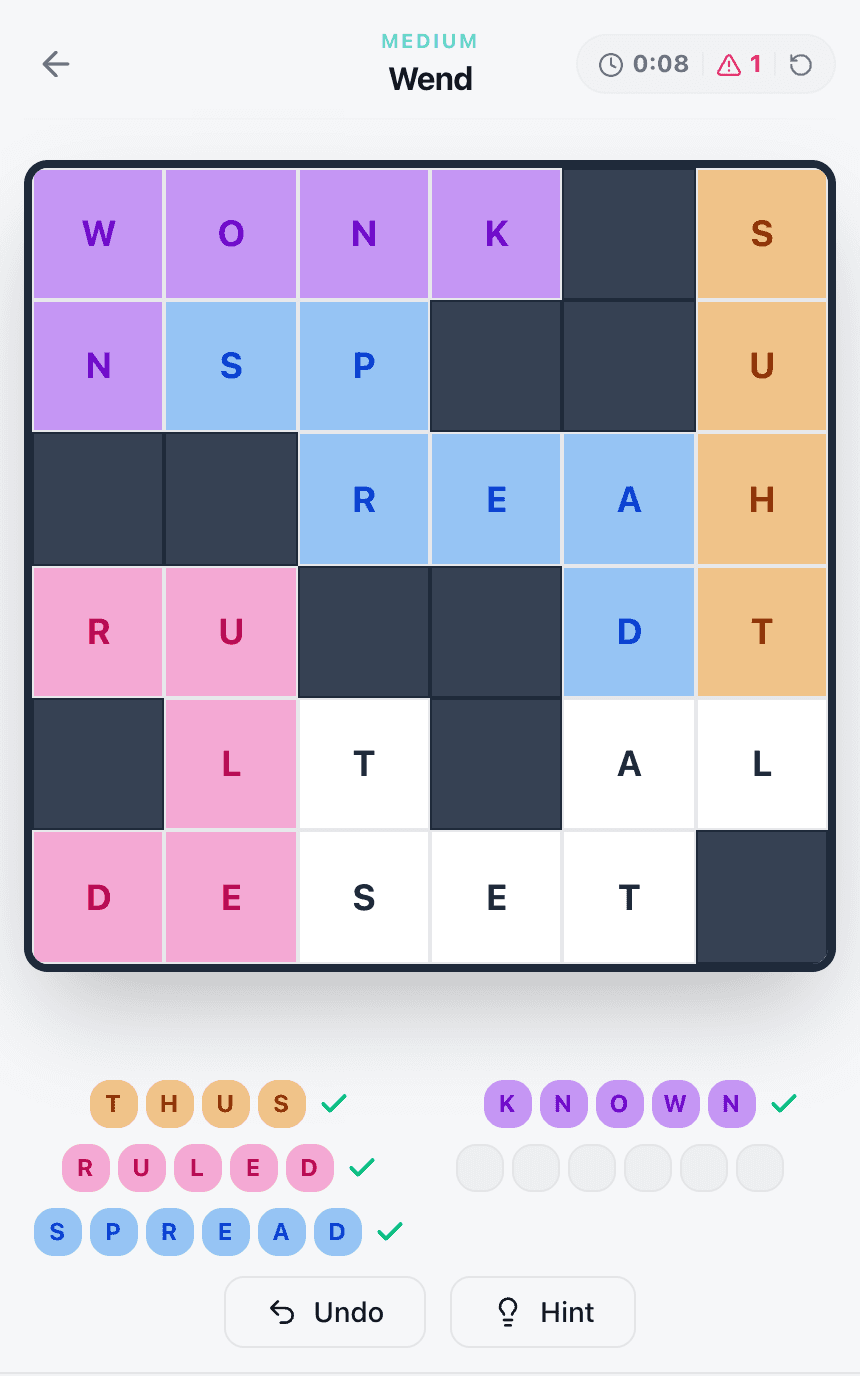
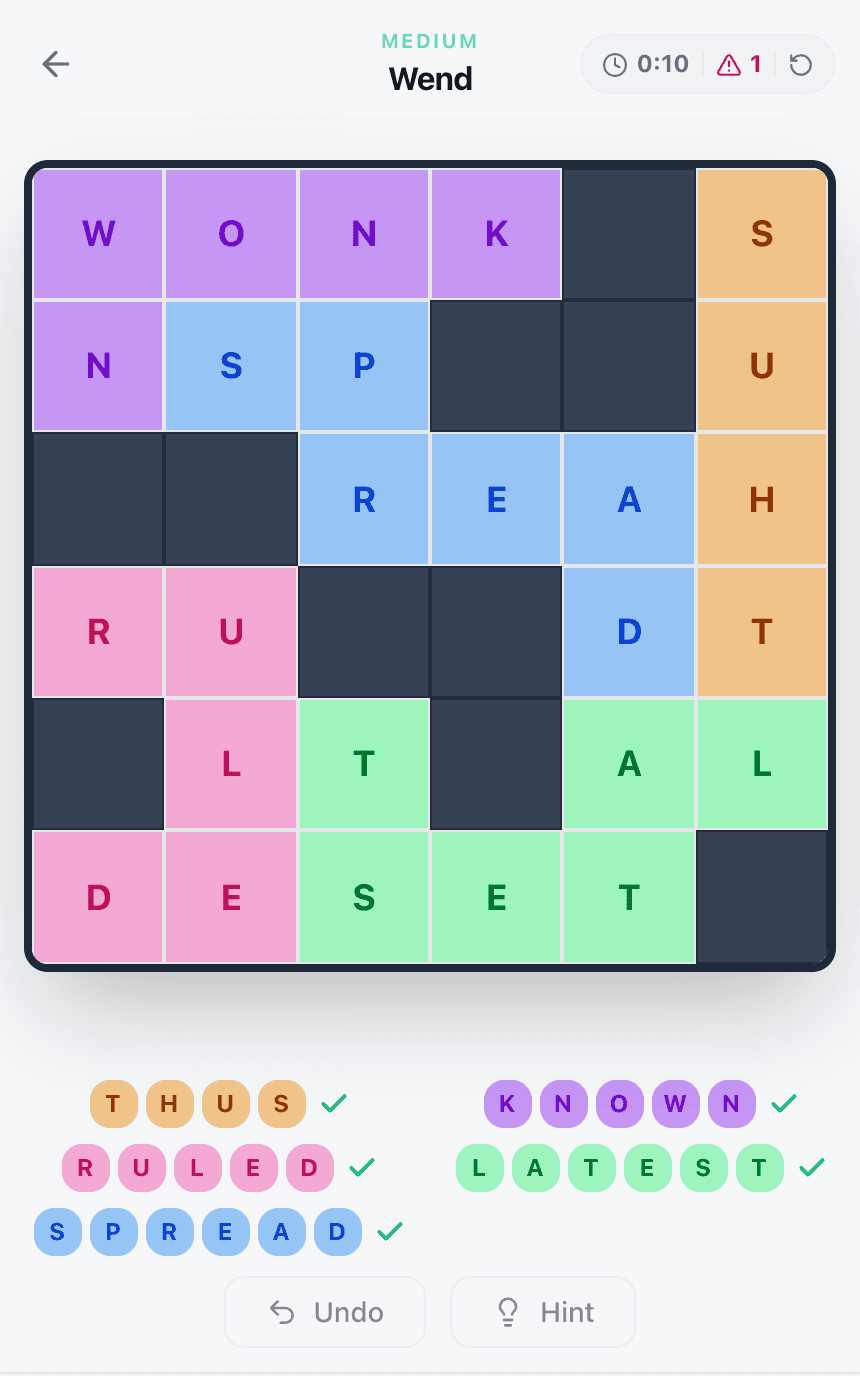
Six white tiles, one six-letter slot. There is nothing to search for. The tiles form a single corridor with no branches, so the last word is whatever they spell in order. Start at the L on the right edge and follow it round: L, A, T, E, S, T. LATEST. It swallows LATE, TEST and LEST on the way, three more of the four-letter words that were never going to fit.
What This Board Teaches
- Start at the dead ends. A tile with one open neighbour is the first or last letter of its word, and that is a far smaller question than scanning the grid.
- Read the slots before the letters. The lengths are the only information you get about the words, and here they eliminated seven real words before a single trace.
- Look again after every word. Each placement removes neighbours, and new dead ends appear, the way the S did after KNOWN.
- Ask what a path leaves behind. RULES and RULED were equally good words. Only one of them left the D with somewhere to go.
- Read from the end you are sure of, then trace from the first letter. The game accepts a word in one direction only.
- Let the leftovers finish. When the tiles that remain match the one slot that remains, stop searching and just read them.
If You Get Stuck
The Hint button reveals one letter of one hidden word in the slots under the board. Tap it again and it keeps filling in the same word rather than scattering letters around, and when the last letter appears the word places itself on the grid. A hint gives you a word to hunt for, not its route, so the dead-end and leftover checks above still do the placing. A refused trace adds one to the mistake count shown at the end; tapping a single tile does not. The clock does not start until you first touch the board, so reading it costs nothing.
Where to Take It Next
This board was kind: every word had one possible route. That stops being true quickly. On the next board, Medium level 2, one word can be traced along two different routes and only one is accepted, for exactly the reason RULES was refused here. The Medium tier has 250 of these 6×6 boards, and the same six checks carry all the way up to the 9×9 Master grids, where the corridors are just longer.
This same grid was also the daily Wend on 31 July 2026, and every other past daily is still playable in the archive. For the tactics as a checklist rather than a worked board, read the Wend strategy guide; for the full ladder of 2,910 levels, see Wend unlimited; and for a fresh board that everyone gets at once, there is today's daily Wend.
Play Wend
Trace a path through adjacent letters to spell every hidden word. A daily word-path puzzle.